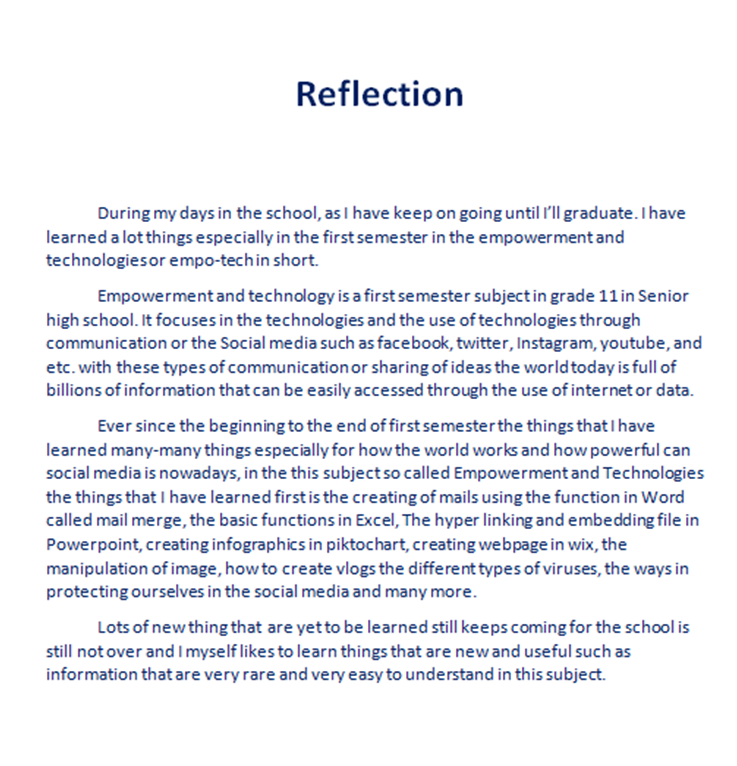
Exercise No. 12 (Reflection)
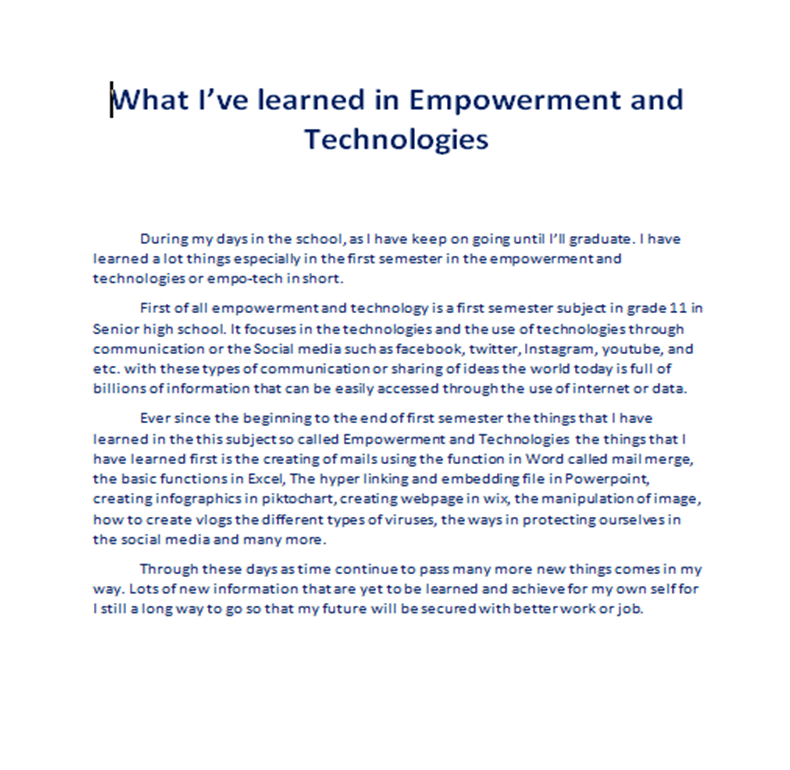

A blog (a truncation of “weblog“) is a discussion or informational website published on the World Wide Web consisting of discrete, often informal diary-style text entries (posts). Posts are typically displayed in reverse chronological order, so that the most recent post appears first, at the top of the web page. Until 2009, blogs were usually the work of a single individual,[citation needed] occasionally of a small group, and often covered a single subject or topic. In the 2010s, “multi-author blogs” (MABs) emerged, featuring the writing of multiple authors and sometimes professionally edited. MABs from newspapers, other media outlets, universities, think tanks, advocacy groups, and similar institutions account for an increasing quantity of blog traffic. The rise of Twitter and other “microblogging” systems helps integrate MABs and single-author blogs into the news media. Blog can also be used as a verb, meaning to maintain or add content to a blog.

Image manipulation is the art of transforming an image to convey what you want, rather than what the original image may have shown. This can be done for artistic reasons, but because of the power of the photograph to show true depictions of reality (and the high regard that people can hold for a picture as evidence), this can also be done for reasons of deceit. The process is sometimes known as airbrushing, after the tools that can be used to achieve the result, or photoshopping, after Adobe Photoshop, the most common image editing tool used in the digital age.

Wix.com Ltd. is an Israeli cloud-based web development platform that was first developed and popularised by the Israeli company also called Wix. It allows users to create HTML5 websites and mobile sites through the use of online drag and drop tools. Along with its headquarters and other offices in Israel, Wix also has offices in Canada, Brazil, Germany, India, Ireland, Lithuania, the United States, and Ukraine.

Infographics (a clipped compound of “information” and “graphics“) are graphic visual representations of information, data or knowledgeintended to present information quickly and clearly. They can improve cognition by utilizing graphics to enhance the human visual system’s ability to see patterns and trends. Similar pursuits are information visualization, data visualization, statistical graphics, information design, or information architecture. Infographics have evolved in recent years to be for mass communication, and thus are designed with fewer assumptions about the readers’ knowledge base than other types of visualizations. Isotypes are an early example of infographics conveying information quickly and easily to the masses.




Microsoft PowerPoint is a presentation program, created by Robert Gaskins and Dennis Austin at a software company named Forethought, Inc. It was released on April 20, 1987, initially for Macintosh computers only.Microsoft acquired PowerPoint for $14 million three months after it appeared. This was Microsoft’s first significant acquisition, and Microsoft set up a new business unit for PowerPoint in Silicon Valley where Forethought had been located. Microsoft PowerPoint is one of many programs run by the company Microsoft and can be identified by its trademark orange, and P initial on the logo. It offers users many ways to display information from simple presentations to complex multimedia presentations.

 Site Title